


Handcuffed Authority: The Arrest of Tuskegee Coach Benjy Taylor and the Conditional Power of Black Leadership (Analysis)

INTRODUCTION
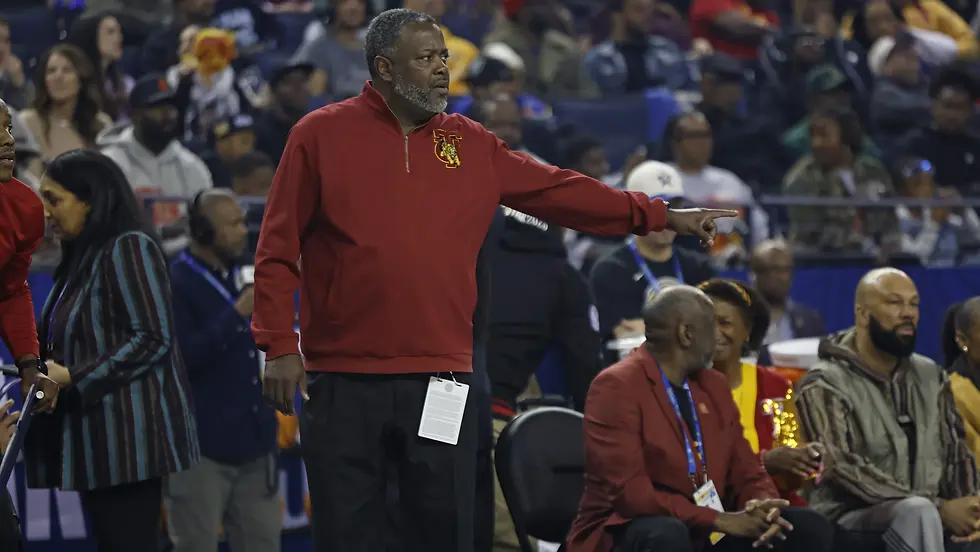
Benjy Taylor did not leave Forbes Arena on a bus.
He left in handcuffs—past his players, past their families, and into a hallway where Black authority has always gone to be diminished.
On Saturday night, following a routine postgame handshake between Tuskegee University and Morehouse College, Taylor—the Golden Tigers’ head basketball coach—was escorted off the court by security after asking that non-participating football players be removed from the handshake line. No punches were thrown. No arrests were warranted. No charges were filed.
Yet the image is now fixed: a Black coach in cuffs, publicly stripped of authority inside a Black institution, for attempting to enforce order.
This moment matters not because it was chaotic, but because it was revealing. It exposed a truth many Black professionals already understand but are rarely allowed to say out loud: Black authority is conditional. It exists only until it causes discomfort.
WHAT ACTUALLY HAPPENED
Video footage circulating online shows the moments after the game—players exchanging handshakes while members of Morehouse’s football team trailed closely behind, shouting obscenities toward Tuskegee players and families. According to Taylor and Tuskegee athletic director Reginald Ruffin, the situation represented a breach of conference-mandated security protocols.
Taylor asked a security officer to remove the football players from the line.
That request—measured, procedural, and aimed at de-escalation—became the justification for escalation.
The officer later claimed Taylor was “very aggressive.” Ruffin flatly rejected that characterization, stating Taylor simply asked security to do its job. Minutes later, Taylor was handcuffed and escorted out of the arena.
He was not charged. He was not detained beyond the incident. He rode the bus home with his team.
But the damage was already done.
HUMILIATION IS A TOOL, NOT A MISTAKE
Handcuffs are not neutral. They are not a misunderstanding. They are a message.
When Benjy Taylor was placed in cuffs, the issue ceased to be about security and became about hierarchy. In moments like these, the purpose is not safety—it is correction. Authority is not debated; it is negated.
This is how Black leadership is disciplined in public spaces. Not through policy review. Not through conversation. Through spectacle.
Black professional authority is not revoked through evidence.It is revoked through discomfort.
A PATTERN HIDING IN PLAIN SIGHT
This incident fits a familiar pattern. Black principals removed from school board meetings. Black professors detained during campus protests. Black coaches arrested during disputes that would earn white counterparts a warning and a walk-through.
The escalation is always immediate.
The justification is always subjective.
The outcome is always public.
Words like aggressive and noncompliant do heavy lifting here. They convert leadership into liability. They allow institutions to outsource judgment to law enforcement rather than confront their own failures.
WHY THIS CUTS DEEPER AT MOREHOUSE
This did not happen at just any gym.
It happened at Morehouse.
Morehouse’s legacy is inseparable from Black leadership, moral clarity, and disciplined resistance. That legacy is precisely why this failure resonates so sharply. When postgame security collapsed, law enforcement filled the vacuum. And when that happened, the oldest playbook in American public life took over.
This is not about malice. It is about exposure.
Legacy does not immunize an institution from reproducing harm—it only raises the standard by which failure is judged.
If Black authority cannot be protected on the court of a Black college, then its protection elsewhere is a polite fiction.
THE SILENCES THAT MATTER MOST
No administrator stepped between Coach Taylor and the cuffs.
No official halted the escalation.
No voice intervened before authority was replaced with force.
Those silences are institutional choices.
What NCAA Rules Say About the Postgame Handshake Line
At the NCAA level, the postgame handshake line is not a free-for-all. It is treated as a controlled, limited interaction tied directly to sportsmanship and game security.
1. Who Is Allowed in the Handshake Line
Under NCAA men’s basketball sportsmanship and bench control principles:
Only uniformed student-athletes who participated in the game are permitted on the court during postgame activities.
Coaches may participate briefly to greet opposing coaches.
Non-participating athletes, including players from other sports (e.g., football), are not authorized to enter the handshake line or intermingle on the court.
This is not a courtesy rule—it is a crowd-control and de-escalation standard.
2. Bench Control and Institutional Responsibility
The NCAA places responsibility squarely on the host institution to maintain order immediately following the game.
Key expectations include:
Keeping non-essential personnel off the playing surface
Preventing verbal taunting or confrontations
Ensuring a clear security presence during handshake procedures
Removing individuals who create or contribute to disorder
Failure to do so can result in conference sanctions or institutional discipline, which is exactly what occurred when the SIAC later fined Morehouse.
3. Sportsmanship Rules and Verbal Conduct
NCAA sportsmanship guidelines explicitly prohibit:
Taunting
Profanity directed at opponents
Actions that incite hostility or retaliation
If Morehouse football players were:
Yelling obscenities
Trailing the handshake line
Engaging players or families
Then they were already in violation, regardless of what followed.
4. Coaches’ Authority During Postgame Transitions
Coaches are not bystanders during postgame procedures.
They are expected to:
Protect their players
Identify unsafe conditions
Request security intervention when protocols are breached
A coach asking security to remove unauthorized individuals is acting within expected professional responsibility, not escalating a situation.
Nothing in NCAA guidance authorizes law enforcement to:
Handcuff a coach
Remove them from the venue
Treat a procedural request as criminal conduct
Absent violence or refusal to comply with lawful orders, such escalation is unsupported by NCAA norms.
5. Why This Matters in the Taylor Case
When you line the rules up against the facts:
Unauthorized individuals were on the court ✔️
Obscenities were allegedly being shouted ✔️
A coach requested enforcement of protocol ✔️
The coach was handcuffed instead of the violation being corrected ❌
That is a complete inversion of responsibility.
The enforcement mechanism targeted the authority figure instead of the breach.
Bottom Line
NCAA rules envision the handshake line as:
Brief
Controlled
Limited to participants
Closely monitored by host security
They do not envision:
Inter-sport mingling
Verbal harassment
Or the criminalization of a coach enforcing order
Which is why this incident resonates beyond one game.
It wasn’t just a breakdown of security.
It was a breakdown of who authority is allowed to belong to—and when.
THE LEGAL QUESTIONS—AND THE REAL PRECEDENT

Civil rights attorney Harry Daniels has confirmed that Taylor was never charged with a crime and is exploring legal action. The legal questions are straightforward: unlawful detention, excessive escalation, and failure to adhere to mandated security protocols.
But the larger issue isn’t whether a lawsuit succeeds.
The precedent already has.
The image of a respected coach being publicly handcuffed for enforcing safety protocols will outlive any settlement, any apology, any quietly issued policy memo. That asymmetry—between momentary justification and permanent reputational harm—is the punishment.
CONFERENCE ACCOUNTABILITY, AFTER THE FACT
Only after public scrutiny did the Southern Intercollegiate Athletic Conference fine Morehouse for failing to meet conference safety standards. That acknowledgment confirms what video and testimony already made clear: the breakdown was institutional, not personal.
Reactive accountability is not accountability. It is damage control.
THE MORAL INDICTMENT
A coach acted to protect his players.
An institution failed to manage its space.
Law enforcement chose humiliation over de-escalation.
A conference enforced standards only after the fallout.
And a Black man with decades of earned authority was reminded—on camera—that it is still conditional.
If a respected coach can be handcuffed for enforcing protocol inside an HBCU arena, what does authority actually buy any of us?
Institutions don’t fail when they make mistakes.They fail when they normalize them.


Comments