


Pentagon Press Lockdown Analysis: Pentagon Pete’s Press Policy Will Blow Up in His Face
INTRODUCTION
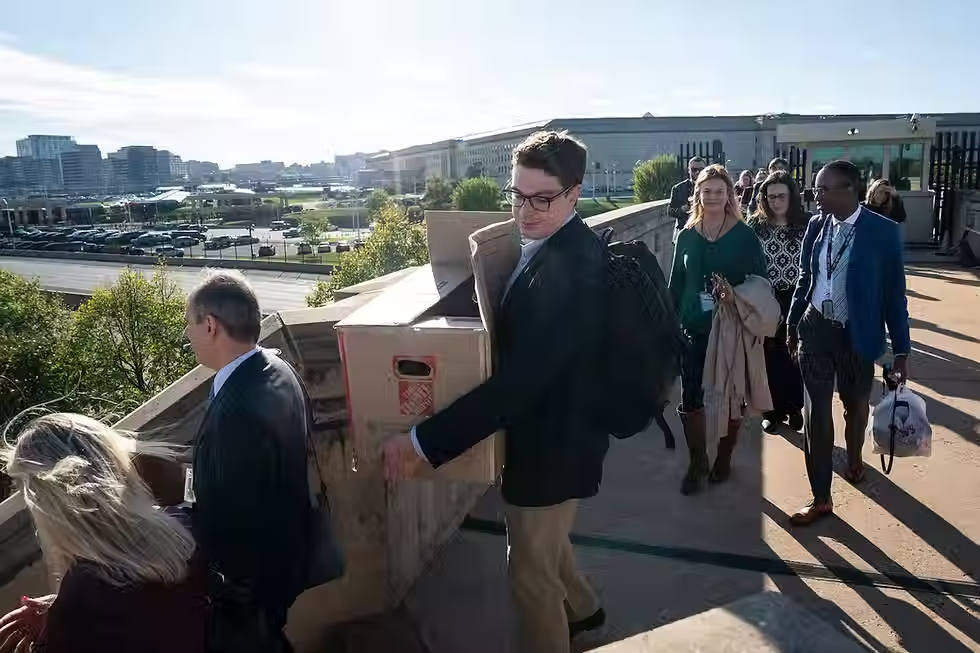
In his latest act of political muscle, Defense Secretary Pete Hegseth tried to muzzle the media by forcing reporters to sign a loyalty-style agreement just to enter the Pentagon. The press corps refused. Now, Hegseth’s attempt to control the narrative will backfire spectacularly. Instead of silencing critics, he’s liberated them.
The Pentagon Press Corps, long confined within the E-Ring walls and public affairs talking points, is now fully outside — and free. What Hegseth doesn’t realize is that all the people who actually know what’s going on in the Department of Defense — the seasoned generals, the career civilians, the strategists with decades of experience — are also outside the building. Many of them were purged, retired, or sidelined by Trump. By cutting off press access, Hegseth has effectively handed the media a golden ticket to go straight to those very people — the ones he can’t control.
It’s like trying to shut down gossip in the barbershop by kicking everybody out—only to realize that all they did was take the conversation to the sidewalk. The gossip doesn’t stop; it just gets louder, realer, and more free.
This moment isn’t just a bureaucratic blunder. It’s a lesson in hubris — and how power, when wielded without wisdom, can undo itself.
DISCUSSION
The Attempt to Control the Narrative
Hegseth’s policy demanded that journalists acknowledge penalties for “soliciting information” from Pentagon officials — a rule that, in practice, would criminalize basic reporting. Networks across the political spectrum — from CNN to Newsmax — refused to sign. The intent was clear: limit leaks, suppress dissent, and centralize control over defense messaging.
But this top-down model misunderstands how information ecosystems actually work. The Pentagon isn’t a fortress of secrets anymore — it’s a network. And the network extends far beyond the walls of the building itself.
The “Exiles” Are Now the Sources
When Trump and Hegseth began purging the ranks of generals, analysts, and civilian experts they deemed “disloyal,” they assumed those people would fade into obscurity. Instead, they’ve become the most credible voices outside government. Retired General Mark Milley. Former Defense Secretary Lloyd Austin. Countless mid-level analysts now teaching at war colleges, think tanks, or serving as defense contractors.
They are no longer bound by classifications, clearances, or the chain of command. They can speak freely — and they will. The press, no longer bound by the Pentagon’s restrictive access policies, will now rely on them more than ever.
In trying to seal the doors, Hegseth created a shadow Pentagon — one that’s freer, faster, and far more transparent than the one he’s trying to control.

A Blow to Credibility
Historically, the Pentagon’s credibility relied on access and transparency. Reporters embedded in briefings or granted interviews with officials often tempered their coverage in exchange for access. That delicate balance is now broken. With no access to lose, reporters have no incentive to hold back.
This creates a dangerous paradox for Hegseth: he’s removed the very oversight that helped contain speculation. Now, instead of carefully framed press briefings, stories will emerge from independent analysis, leaked memos, and the voices of those he pushed out.
And in the information age, knowledge is power. And perception is reality. Once the narrative leaves the building, no amount of “policy discipline” can bring it back.
The “Pentagon Underground”
Make no mistake — the new “press corps” isn’t in the Pentagon anymore. It’s in Arlington coffee shops, in Zoom calls with retired generals, and at think tank roundtables. Every attempt to silence them will only strengthen their resolve and expand their network.
What’s more, this situation mirrors the Pentagon Papers era: when attempts to suppress information only led to more exposure. Reporters now have the freedom to interview the most experienced defense voices without waiting for approval or risking access. The irony? Many of those experts were once the very people Hegseth or Trump deemed “the problem.”
In many ways, Hegseth’s clampdown mirrors the paranoia of the Nixon era. When Daniel Ellsberg leaked the Pentagon Papers in 1971, the White House’s obsession with secrecy created the very scandal it feared. The harder Nixon tried to control the message, the more the truth metastasized in the public square. Today’s Pentagon lockdown repeats that same mistake—assuming that control of the building equals control of the narrative. But in an age of social media, think tanks, and retired generals with podcasts, the truth doesn’t need a podium—it just needs good Wi-Fi.
Strategic Misfire
For all of Hegseth’s talk about discipline and control, this move shows a profound misunderstanding of modern warfare — especially in the information domain. He’s fighting a 20th-century propaganda battle in a 21st-century media environment.
Information warfare isn’t about suppressing data — it’s about shaping perception. And by alienating the press, Hegseth has lost the ability to shape anything.
“Information Warfare 101”
In military strategy, information is not just a domain—it’s a battlespace. U.S. doctrine defines “information dominance” as the ability to collect, control, and communicate truth faster than your adversary. By locking out the press, Hegseth has surrendered that battlespace voluntarily. He’s fighting a 21st-century information war with 20th-century censorship tactics, mistaking silence for control. But suppression is not a strategy—it’s a void, and nature abhors a vacuum.
Every time the Pentagon stonewalls a journalist, it loses ground in the war of perception. Public trust, once eroded, doesn’t regenerate on command. By denying access, Hegseth has unintentionally created an open-source battlefield where every tweet, Substack, and retired general becomes a competing center of gravity. In doctrine terms, he’s ceded the initiative—and once you lose initiative in any fight, you’re no longer shaping events, you’re reacting to them.
CONCLUSION
Pete Hegseth set out to silence critics and control the story. Instead, he’s built the perfect echo chamber for everyone he tried to erase. The retired generals, the ousted analysts, the investigative journalists—they now form a chorus that doesn’t need Pentagon access to speak truth. And history is clear: when governments close their doors, they don’t stop leaks—they start floods.
Pete Hegseth thought he was tightening control over the Pentagon’s message. Instead, he’s handed the narrative to those he can’t command — the independent press and the veterans of the defense establishment who now speak freely. The lesson here is timeless: control without credibility is collapse in slow motion. And you can’t win a war of ideas by locking yourself inside the fortress.
This isn’t just a tactical misstep; it’s a strategic failure. By driving the press out of the Pentagon, he’s ensured that every conversation, every leak, and every revelation will unfold beyond his reach and at light speed.
In the end, you can’t control the story when you’ve locked yourself out of it.
MInd you, you would think that a guy who worked at Fox News would have a better understanding of how the press, strategic messaging, and organizational reporting works, but apprently not so much.
Call to Action: The American public must demand transparency in its defense institutions. The Pentagon belongs to the people — not to politicians with fragile egos.


Comments