


The Law Is a Two-Way Street: How Trump’s Legal Strategy Came Back Around

American law loves precedent.
Not just the kind written in case reporters—but the kind established in strategy.
What we are watching unfold in the Luigi Mangione case is not some rogue or novel defense theory. It is not a legal stunt invented out of thin air. It is the direct descendant of a playbook popularized, refined, and normalized by Donald Trump’s legal team.
And now, that same logic is being used against a Trump-aligned Justice Department.
The law, it turns out, really is a two-way street.
The New Defense That Isn’t New at All
Luigi Mangione’s attorneys argue that Attorney General Pam Bondi’s decision to seek the death penalty in the killing of Brian Thompson is tainted.
Why?
Because Bondi previously worked as a lobbyist at a firm that represented the parent company of UnitedHealthcare.
The defense claim is straightforward:
Prior financial alignment
Potential institutional bias
Discretion exercised under a cloud of conflict
The implication is even more direct:
This isn’t neutral justice. It’s compromised prosecution.
If that sounds familiar, it should.
Trump’s Fani Willis Defense: The Blueprint
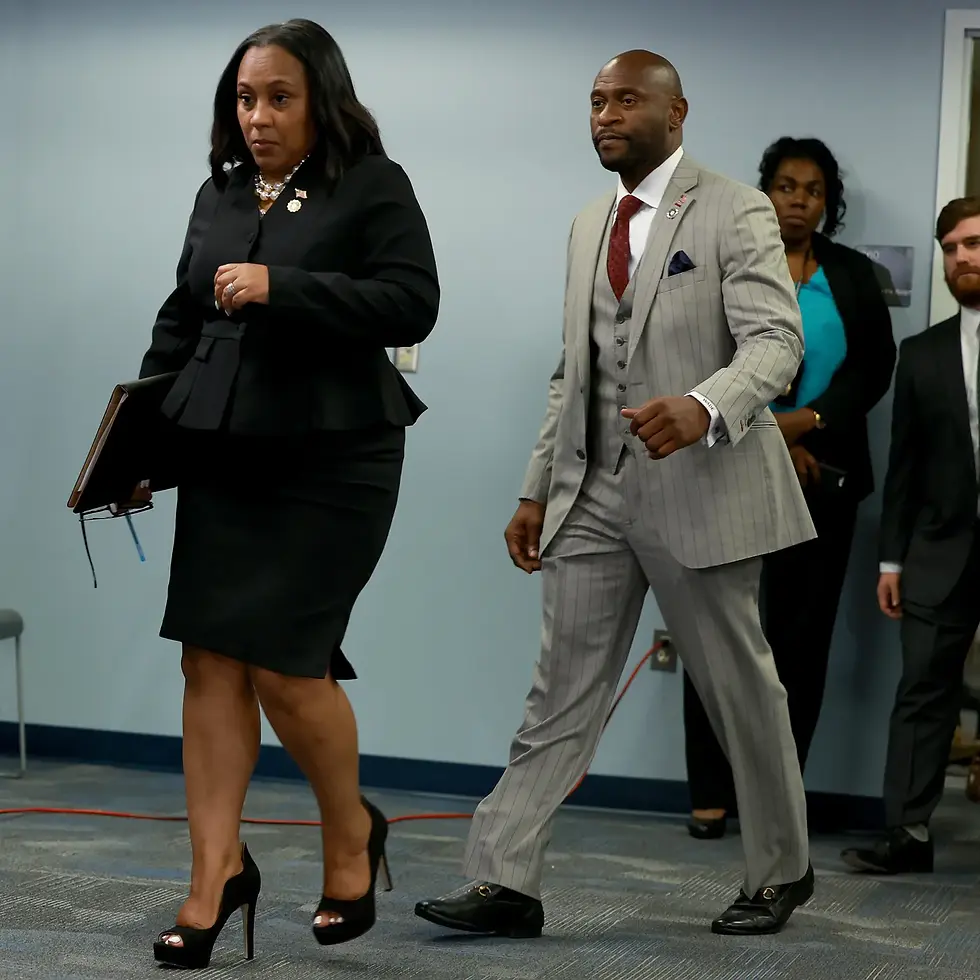
This argument did not originate with Mangione.
It was field-tested in real time by Donald Trump’s legal team in Georgia.
In Trump’s RICO case, his lawyers did not initially center their argument on innocence.
Instead, they focused on the prosecutor herself—Fani Willis.
Their claim:
Willis had a personal relationship with special prosecutor Nathan Wade
That relationship created financial and ethical conflicts
Therefore, her charging decisions were compromised
And the legitimacy of the prosecution was in question
This was a strategic pivot that mattered far beyond Trump’s case.
Because once you convince courts—and the public—that prosecutorial motive matters as much as prosecutorial conduct, you open a door that cannot be closed selectively.
The Critical Shift: From Crime to Credibility
This is the heart of the precedent Trump’s legal team set.
Traditionally, criminal defense centers on:
Did the defendant commit the act?
Can the state prove intent?
Is the evidence sufficient?
Trump’s defense shifted the frame:
Who is prosecuting?
What do they gain?
What relationships or incentives exist?
In other words:
The prosecutor became the subject of scrutiny, not just the defendant.
That move worked—not necessarily to end the case outright, but to pollute the legitimacy of the process, inject doubt, and create appellate leverage.
Mangione’s lawyers are now walking through the same door.
Same Legal Logic, Different Facts
Strip away the politics and personalities, and the structure is identical.
Trump Case | Mangione Case |
Personal relationship | Financial/professional relationship |
Alleged benefit | Alleged institutional bias |
Prosecutor’s neutrality questioned | Prosecutor’s neutrality questioned |
Process challenged | Process challenged |
Legitimacy undermined | Legitimacy undermined |
The argument is not that Pam Bondi committed a crime—just as Trump’s lawyers did not initially argue Fani Willis committed one.
The argument is subtler and more corrosive:
A conflicted prosecutor cannot wield unconflicted power.
Once that principle is accepted, it applies universally—or it applies to no one.
Why This Argument Keeps Spreading
Trump didn’t just use this defense.
He mainstreamed it.
High-profile defendants now understand that:
You don’t have to beat the facts
You just have to muddy the authority
You don’t need exoneration
You need delegitimization
This strategy:
Plays well in the media
Resonates with public cynicism
Creates appealable issues
Weakens institutional trust
And once courts entertain these claims—even partially—they become fair game for everyone else.
Including people the Trump movement doesn’t like.
The Irony No One Can Avoid

Here’s the uncomfortable truth:
Mangione’s defense is using Trump’s own legal philosophy against a Trump-aligned Attorney General.
Same weapon.
Same logic.
Different target.
If Trump’s team was right that:
Relationships matter
Incentives matter
Conflicts matter
Then Mangione’s lawyers are doing exactly what competent defense counsel should do.
You cannot argue that a tactic is valid when it protects you—and illegitimate when it’s turned around.
That’s not law.
That’s preference.
The Law Doesn’t Care Who You Voted For
This moment exposes a deeper reality about American law:
Once a defense strategy becomes normalized, it loses ideological ownership.
You don’t get to patent it.
You don’t get to revoke it.
And you don’t get to complain when it’s used against your side.
Trump’s legal team widened the lane.
Now others are driving in it.
Conclusion: Precedent Cuts Both Ways
The Mangione case is not just about one defendant, one prosecutor, or one crime.
It is about what happens when legal tactics reshape norms.
Trump’s team taught the country that process can be attacked as aggressively as substance.
Now the system is living with the consequences.
The law is not a one-way weapon.
It is a two-way street.
And once you pave it, you don’t get to decide who travels on it.
What Black America Should Take From This (And How to Use It)

For Black America, this moment is not about rooting for or against Luigi Mangione. It’s about recognizing a usable precedent—one that has historically been denied to us, even when the facts justified it.
For decades, Black defendants have been told—implicitly and explicitly—that process arguments were excuses, that questioning prosecutors was “deflection,” and that justice would come if we just cooperated. Meanwhile, power learned something else entirely: the system bends when its legitimacy is challenged, not when its morality is appealed to.
Trump’s legal team didn’t ask for fairness.
They demanded scrutiny.
That distinction matters.
The Lesson: Prosecutors Are Not Untouchable
The most important takeaway is this: prosecutorial neutrality is no longer presumed. It can be interrogated, litigated, and publicly contested.
For Black defendants—who have long faced:
Overcharging
Discretionary sentencing disparities
Politicized prosecutors running for higher office
This precedent opens a strategic lane that was often treated as off-limits.
If wealthy, White defendants can argue that:
Relationships create bias
Prior affiliations taint judgment
Incentives shape punishment
Then Black defendants—who are disproportionately impacted by those same dynamics—have every right to deploy that logic aggressively.
Stop Arguing Morality. Start Arguing Process.
Historically, Black advocacy has often leaned on moral appeal:
“This is unjust”
“This is unfair”
“This harms our community”
Those arguments are true—but they are rarely dispositive in court.
What moves judges is process.
Trump’s defense made clear that:
You don’t win by proving the system is wrong. You win by proving the system didn’t follow its own rules.
Black America must internalize this shift.
The question is no longer:
“Was the outcome racist?”
It is:
“Who exercised discretion?”
“What incentives did they have?”
“What relationships shaped that discretion?”
“What conflicts were disclosed—or not?”
That is how power speaks to itself.
This Is Especially Potent in Death Penalty and High-Discretion Cases

Death penalty cases, charging enhancements, habitual offender statutes, and prosecutorial election cycles are fertile ground for this strategy.
Black defendants are:
More likely to face aggressive charging
More likely to be used as political symbols
More likely to encounter prosecutors seeking “tough on crime” credentials
The Mangione argument shows that motive and background matter when the state exercises irreversible power.
That door is now open wider than it has been in decades.
This Requires Legal Sophistication, Not Just Outrage
Here’s the uncomfortable part: This strategy only works if Black America invests in legal literacy, not just protest.
It means:
Defense attorneys who aggressively pursue discovery on conflicts
Community pressure that focuses on prosecutorial transparency
Media framing that interrogates who benefits from certain prosecutions
Political organizing around prosecutor elections and appointments
Power didn’t beat the system by being louder.
It beat the system by being procedurally fluent.
The Hard Truth—and the Opportunity
Trump didn’t create prosecutorial bias.
He exposed how to weaponize its acknowledgment.
That tool now exists in the open.
Black America has spent generations on the receiving end of discretionary justice. What this moment proves is that discretion can be challenged, not just endured.
The law is a two-way street—but only for those who know how to drive on it.
The lesson here isn’t imitation of Trump.
It’s understanding the rules of the game he forced into daylight.
And using them—without apology.


Comments