


$1 Trillion a Year for Defense — So Where the Hell Is the Money Going?
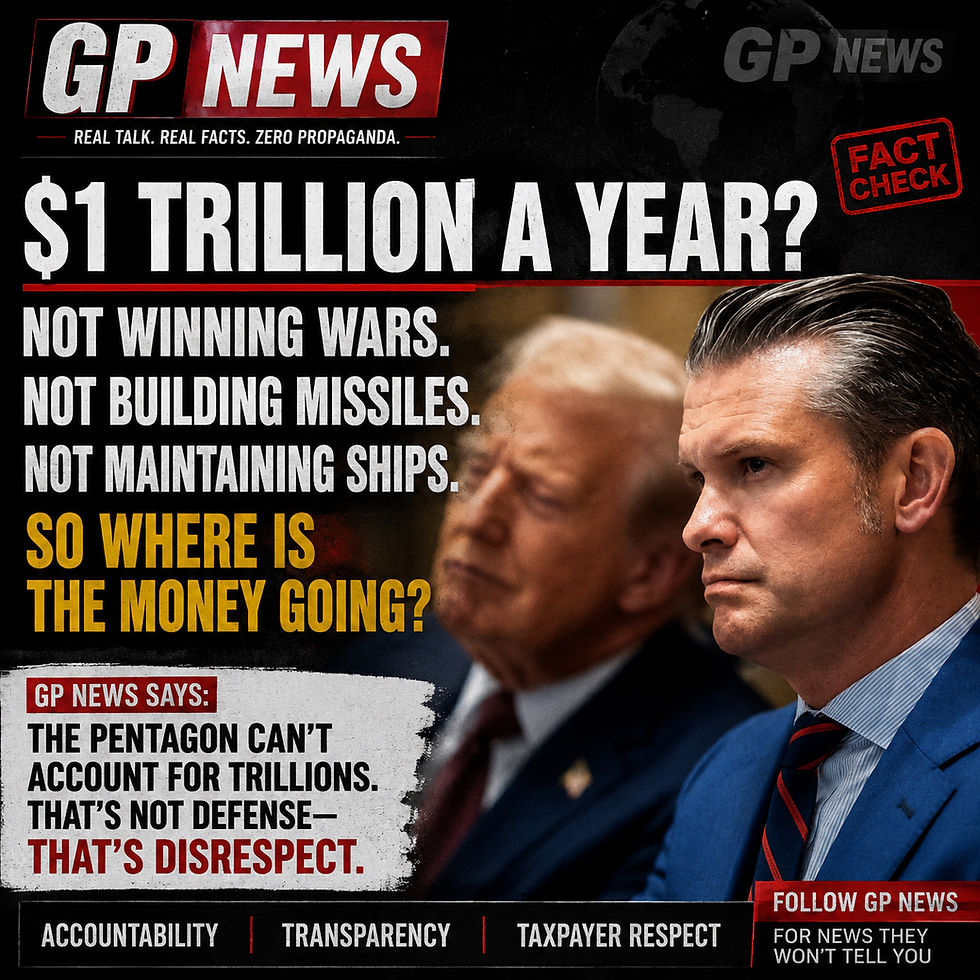
America has crossed a line that would have sounded almost absurd a generation ago: trillion-dollar defense budgets are becoming the new normal.
The Pentagon’s FY2026 request totaled $961 billion, including $113 billion supplied through the 2025 reconciliation law. The Trump administration itself described its overall defense topline, combining mandatory and discretionary spending, as exceeding $1 trillion. And Congress is already considering FY2027 Pentagon spending above the trillion-dollar mark.
That’s a hell of a lot of money.
So here’s the uncomfortable question:
What exactly are we buying?
Because Americans are watching ships struggle with maintenance. Shipbuilding schedules continue to slip. Weapons inventories take years to replenish. Missile production cannot simply be turned on like a faucet. And after eight full financial audits, the Pentagon still cannot obtain a clean audit opinion.
In FY2025, auditors examined a Department of Defense responsible for approximately $4.6 trillion in assets and issued another disclaimer of opinion because they could not obtain enough reliable evidence to determine whether the department-wide financial statements were fairly presented.
Let’s be precise: that does not mean the Pentagon “lost $4.6 trillion.”
It means something arguably more embarrassing for the world’s most expensive military:
The Pentagon still cannot adequately prove what it owns, what some of it is worth, and whether all of its financial records are reliable.
Meanwhile, taxpayers keep writing bigger checks.
WHO IS SUPPOSED TO BE WATCHING THIS MONEY?
There isn’t one watchdog. There is supposed to be an entire ecosystem of oversight.
Congress controls appropriations and conducts oversight through committees such as Armed Services, Appropriations, and their subcommittees. The Government Accountability Office independently investigates federal programs and reports to Congress. The Congressional Budget Office analyzes defense spending and long-term costs.
And inside the Pentagon sits one of the most important watchdogs of all: the Department of Defense Inspector General.
The IG audits programs, investigates misconduct, and looks for fraud, waste and abuse.
In other words, when you’re spending close to a trillion dollars every year, these are some of the people whose job is to ask:
Where did the money go?
Then Donald Trump came back into office.
In January 2025, Trump fired inspectors general across the federal government. Among them was Robert Storch, the Pentagon’s inspector general.
Think about the optics of that.
You have the largest, most complicated department in the federal government — an organization that had already repeatedly failed its audits — and one of the administration’s early moves was removing its independent watchdog.
And then we started talking about giving the Pentagon even more money.
That’s not exactly how you inspire confidence in the books.
THE REAL PROBLEM ISN’T THAT AMERICA DOESN’T SPEND ENOUGH
America’s defense problem increasingly looks less like a money problem and more like a conversion problem:
How efficiently does a dollar appropriated for national defense become actual combat power?
That’s the question nobody in Washington seems particularly eager to answer.
CBO says DoD’s FY2026 request included roughly $384 billion for acquisition — procurement plus research, development, testing and evaluation — and another $362 billion for operations and maintenance.
Those are absolutely staggering numbers.
Yet money appropriated isn’t the same thing as a missile in a magazine.
Money obligated isn’t a repaired ship.
Money spent isn’t a functioning supply chain.
And a trillion-dollar topline isn’t the same thing as readiness.
If China, Russia or Iran doesn’t care how much America spent — only what America can actually put into the fight — then neither should we.
AND THEN COME THE MIDTERMS
This is where November 2026 could become very important.
Congress doesn’t just write the checks.
Congress can demand the receipts.
If control of either chamber changes hands, committee leadership and investigative priorities can change with it. A new majority could use hearings, subpoenas, document requests and the appropriations process to scrutinize Pentagon spending and Trump administration defense decisions far more aggressively.
That doesn’t automatically mean lower defense spending.
In fact, plenty of Democrats and Republicans support enormous defense budgets.
But divided government could mean something the Pentagon and White House have faced much less of recently:
hostile oversight.
And considering Defense Secretary Pete Hegseth has recently faced bipartisan criticism for excluding Democratic lawmakers from classified defense-budget discussions, the relationship between the Pentagon and a differently controlled Congress could get ugly very quickly.
Imagine congressional hearings asking a very simple question:
We gave you nearly a trillion dollars. Show us what America got for it.
That shouldn’t be a Republican question.
It shouldn’t be a Democratic question.
It should be a taxpayer question.
Because national defense isn’t measured by the size of the Pentagon’s budget.
It’s measured by whether the United States can deter a war — and win one if deterrence fails.
If we’re spending a trillion dollars a year while struggling to build ships, replenish weapons, maintain equipment and produce financial statements that auditors can actually verify, then maybe Washington has been asking the wrong question.
The question isn’t:
“How much more money does the Pentagon need?”
The question is:
“What the hell happened to the money we already gave you?”
GP NEWS — Real Talk. Real Facts. Zero Propaganda.



Comments