


Todd Blanche Was the Price of Getting Out of Town
Analysis: Senate Republicans gave Trump his attorney general — and quietly escaped his SAVE America Act trap
Sometimes the most important vote in Washington is the one Congress manages not to take.
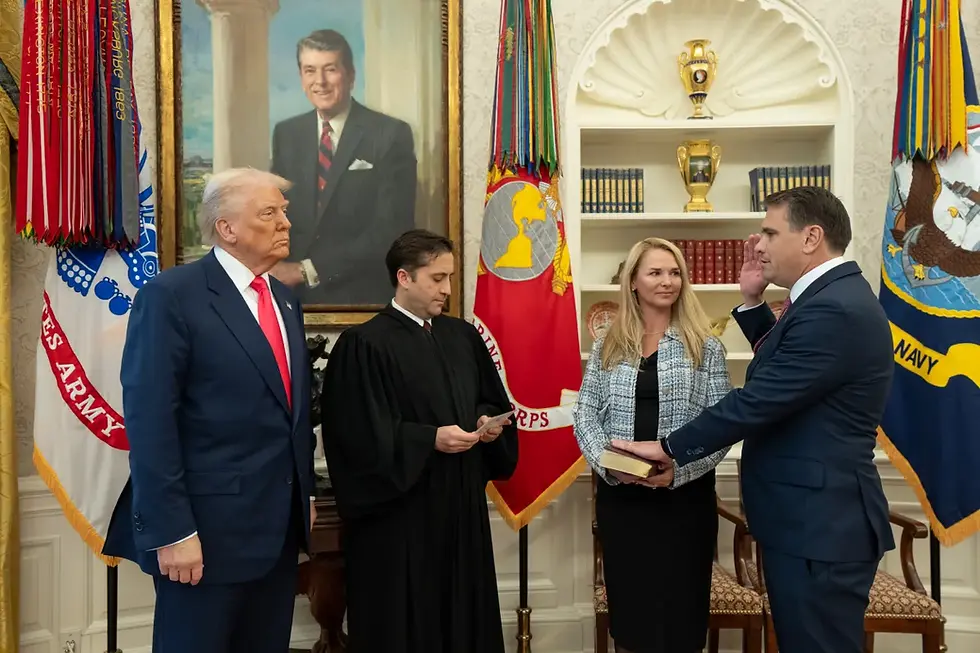
Early Saturday morning, Senate Republicans narrowly confirmed Todd Blanche as attorney general, 50-49, installing Donald Trump’s former personal criminal-defense attorney as the nation’s chief law-enforcement officer. Republicans Susan Collins and Lisa Murkowski joined every Democrat in opposition; Bill Cassidy supplied the decisive Republican vote.
Then, after nearly 20 hours of Senate business, Republicans packed up and left Washington for recess without delivering what Trump had loudly demanded: passage of the SAVE America Act. They did manage to confirm Blanche, pass government funding and handle other priorities. SAVE stayed behind.
Was there literally a smoke-filled-room agreement saying, “Give Trump Blanche and we can forget about SAVE until September”?
There is no public evidence of that.
But politically?
Come on, now.
Republicans gave Trump a major personnel victory and simultaneously escaped a legislative fight that was forcing them toward a choice many of them absolutely did not want to make.
Blanche Is a Terrible Attorney General Pick

Forget party labels for a moment.
By ordinary standards of Justice Department independence, Todd Blanche is an astonishing choice.
This is Trump's former personal lawyer—the man who defended him in his New York criminal case and federal prosecutions—now controlling the Justice Department. Since entering DOJ leadership, Blanche has helped accelerate investigations of Trump’s perceived enemies, while the department has shed career personnel and increasingly described itself as operating at the president’s direction.
Then came the IRS settlement.
Blanche participated in resolving Trump's lawsuit against the government Trump himself controls, producing an arrangement that included a proposed $1.8 billion “anti-weaponization” fund benefiting people claiming political persecution and protections concerning IRS audits of Trump, his sons and the Trump Organization. Republican senators John Cornyn and Thom Tillis found the arrangement troubling enough to threaten Blanche’s confirmation until he put concessions in writing.
Think about that conflict.
The attorney general represents the United States.
Blanche previously represented Donald Trump.
And now matters involving Donald Trump, Donald Trump’s enemies, Donald Trump’s finances and Donald Trump’s political interests flow through a Justice Department run by…
Donald Trump’s former lawyer.
You don't need a law degree to see the problem.
What Trump Gets

Trump gets something considerably more valuable than another Cabinet secretary.
He gets institutional permanence for loyalty.
An acting attorney general can be portrayed as temporary. A Senate-confirmed attorney general carries the legitimacy of congressional approval.
And Blanche already understands what Trump wants.
Trump has repeatedly demanded investigations and prosecutions involving people he considers enemies. Blanche’s DOJ has already pursued several of those priorities.
Confirmation therefore gives Trump a Senate-approved attorney general who does not need six months to decipher what “retribution” means in Trump-speak.
For Trump, that's a significant win.
And that win gave Senate Republicans political currency to disappoint him somewhere else.
Enter the SAVE America Act.
Republicans Like Voter ID. SAVE Is Something Bigger.

Republicans generally support voter-identification requirements. That isn't the real dispute.
The SAVE America Act goes considerably further. It requires documentary proof of citizenship for registration, establishes stringent nationwide voter-ID rules and places new requirements on absentee ballots. The current legislation would require many mail voters to include copies of identification and would dramatically alter voter-registration systems used across the states.
And Senate Republicans have already demonstrated that GOP support is not universal.
In April, Republicans Thom Tillis, Lisa Murkowski, Susan Collins and Mitch McConnell joined Democrats to defeat one effort to advance SAVE-related requirements, 48-50.
Why?
Partly because Republicans understand something Trump frequently ignores:
Rules you create for the other side eventually apply to your voters too.
Republicans spent decades building sophisticated absentee-voting operations. Older voters—an important Republican constituency—remain among the heaviest users of mail voting. Republican-led states use absentee systems extensively. Before Trump's post-2020 crusade against mail ballots, the GOP was quite good at them.
And then there’s the military vote—where this bill starts looking less like election security and more like Republicans stepping on their own rake. Federal law created a special absentee-voting system for service members overseas for an obvious reason: a sailor in Yokosuka, a soldier in Germany, or an airman in the Middle East cannot simply swing by the county election office back home.
Yet the SAVE America Act layers new documentary requirements onto registration and mail voting that could force overseas voters into precisely the kind of in-person verification their circumstances make difficult or impossible. Even a military ID, by itself, is not necessarily enough to establish citizenship under the bill; the legislation pairs it with additional service documentation showing a U.S. place of birth.
Republicans can insist that SAVE does not technically ban military absentee ballots. Fine.
You don’t have to ban a ballot to make it harder to cast one. Add enough paperwork, verification steps, deadlines and opportunities for rejection to a system already operating across oceans and time zones, and some legitimate military votes are inevitably placed at greater risk. That is an extraordinary gamble for a party that has spent generations courting military voters—and it helps explain why some Senate Republicans looked at Trump’s demand and apparently decided that “election integrity” was a lot less attractive once the collateral damage included their own voters.
The broader point remains: sweeping attacks on absentee voting can hit constituencies Republicans also depend upon.
And then there is the real elephant in the Senate chamber.
To Get SAVE, Trump Wants Republicans to Blow Up Their Favorite Weapon

Most legislation still needs 60 Senate votes to overcome a filibuster.
Republicans don't have 60 votes for SAVE.
Trump's solution has been characteristically simple:
Kill the filibuster.
That would certainly make governing easier for Trump.
It would also be political malpractice for Senate Republicans.
The filibuster may be the most effective minority-party weapon ever accidentally created by parliamentary procedure. The Senate itself records an explosion in cloture activity over recent decades, reflecting how routinely the 60-vote threshold now shapes legislation.
And nobody mastered that weapon like Mitch McConnell.
Call him the Obi-Wan Kenobi of the filibuster.
During the Obama years, McConnell's Republican minority turned obstruction into an operating doctrine. Cloture fights exploded as Republicans forced Democrats repeatedly to find 60 votes not merely for controversial bills, but nominations and routine Senate business. Researchers have concluded that Republicans have used the legislative filibuster roughly twice as often to stop Democratic legislation as Democrats have used it against Republican legislation. 70 percent of all filibusters have been Republican led.
McConnell understood the mathematics beautifully:
If your opponent needs 60 and only has 55, you don't need to win the argument.
You just need 41.
Why Democrats Haven't Used It As Much
This isn't because Democrats are morally opposed to obstruction. They aren't.
Give any political party a weapon and eventually somebody pulls the trigger.
The difference is structural.
Modern Democrats generally seek more affirmative federal action—voting-rights legislation, labor protections, environmental rules, health programs and regulatory expansion.
Republicans more frequently campaign on stopping, repealing or limiting federal action.
A procedural weapon that makes legislation harder to pass naturally benefits the party whose policy preference more often begins with “don't pass that.”
Republicans therefore learned to use the filibuster as both shield and sword.
Democrats have absolutely used it when in the minority, and they weakened nomination filibusters themselves in 2013 after Republican obstruction of Obama nominees. Republicans subsequently finished the job for Supreme Court nominees in 2017. But the legislative filibuster survived because senators in both parties understand what happens when political control flips.
And That Is Trump's Problem
Trump thinks tactically.
Senate Republicans occasionally have to think institutionally.
Kill the filibuster today and Trump could bulldoze portions of his agenda through a Republican Senate with 51 votes.
Wonderful.
Until Democrats control 51 seats.
Then Republicans could watch a Democratic majority move voting-rights legislation, abortion protections, labor reforms, gun legislation, climate policy and whatever else can command a bare majority—and Republicans would have voluntarily thrown away the weapon they historically wield better than anybody.
That isn't shooting yourself in the foot.
That's shooting yourself in both feet and handing the gun to the next majority.
So Senate Republicans found themselves trapped between Donald Trump's immediate political demands and their own long-term institutional interests.
And Saturday morning they found the exit.
They gave Trump Todd Blanche.
Trump got his loyal attorney general.
Republicans got to go home.
And the SAVE America Act stayed in Washington.
No documented quid pro quo is necessary to see the political tradeoff.
Sometimes in Washington, you understand the deal simply by looking at who got what—and which vote mysteriously never happened.


Comments