


S.C. State Governance Shift: Control, Not Compliance
Updated: May 5

5 Key Takeaways
This wasn’t a routine bylaw update—it was a power consolidation move.
Chairman Douglas Gantt is reducing who gets to see, challenge, and shape decisions in real time.
The Evette controversy exposed a deeper issue: political access is being prioritized over institutional trust.
Removing stakeholder voices may quiet the boardroom—but it will amplify unrest across campus.
S.C. State now faces a real question: Is this the leadership model it wants going forward?
BLUF (Bottom Line Up Front)
S.C. State’s board leadership isn’t just tightening bylaws—it’s reshaping the university’s governance structure to favor political alignment over shared governance. Chairman Gantt appears to be centralizing authority, limiting internal dissent, and positioning the institution to better navigate Republican political power. The risk: in trying to secure protection from Columbia, he may be losing legitimacy in Orangeburg.
What Was Done
The board eliminated non-voting seats held by students, faculty, staff, alumni, and foundation leadership.
On paper, this was framed as legal alignment. In practice, it removed the very people who:
Witness board dynamics
Represent institutional stakeholders
Provide immediate internal accountability
These weren’t just symbolic seats. They were eyes, ears, and voices inside the room.
Now, those voices are pushed out of the boardroom and into controlled committee environments—where influence is filtered, segmented, and easier to manage.
What the Impact Will Be
This move will not reduce tension. It will relocate it.
The boardroom gets quieter
The campus gets louder
Faculty, students, and alumni are not going to interpret this as administrative housekeeping.
They’re going to see it as:
Retaliation for dissent
Political capture of the institution
A signal that their voices are no longer welcome in real decision-making spaces
That’s how you turn a governance tweak into a legitimacy crisis.
Gantt’s Motivation: Command and Control

Let’s be clear—this is strategic.
Gantt has already made his worldview known: S.C. State must maintain strong relationships with a Republican-controlled legislature to survive and secure funding.
That leads to a specific leadership model:
Prioritize access to power
Maintain message discipline
Reduce internal friction
Centralize decision authority
The Pamela Evette invitation fits perfectly into this model. It wasn’t about alignment with the students. It was about proximity to political power.
Same play here:
Fewer voices in the room = fewer disruptions
Fewer disruptions = cleaner political positioning
Cleaner positioning = better access to funding channels
This is governance as political operations.
How the University Will See It
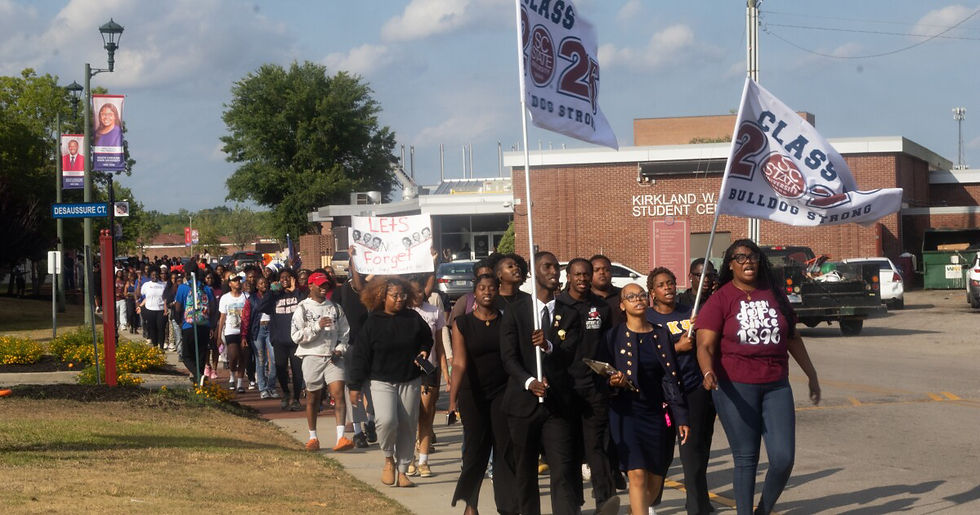
Gantt may see strategy.
The university will see something else entirely.
Students will see:
“You used our graduation for politics—and when we pushed back, you cut our seat at the table.”
Faculty will see:
“Shared governance only exists when it’s convenient.”
Alumni will see:
“The institution is being managed for political comfort, not cultural responsibility.”
That perception matters more than the bylaw language. Because universities don’t run on bylaws alone—they run on trust, identity, and shared ownership.
Before we go deeper—this is exactly the type of analysis we break down weekly. Subscribe so you don’t miss the next one...
The Tactical Error
Gantt’s mistake isn’t that he’s thinking politically.
It’s where and how he chose to execute the strategy.
Commencement is sacred. It’s not a lobbying tool. It’s not a relationship-building platform. It’s not a signal to the statehouse.
By inserting a politically charged figure like Evette into that space, he blurred the line between:
Institutional celebration
Political transaction
Then, instead of expanding stakeholder input after the backlash, the board reduced it.
That sequence sends one message:
When pressure hits, leadership closes ranks instead of opening dialogue.
That’s not strength. That’s defensive governance.
The Unanswered Questions
Even after all of this, key questions remain:
Why was Evette the right speaker for that graduating class?
What tangible value was she bringing to the students?
Who was consulted before the decision was made?
What did S.C. State actually gain from the invitation?
And most importantly—what did it cost?
Because right now, the answer appears to be:
Internal backlash
External political threats
Eroded trust
That’s a bad tradeoff.
The Strategic Miscalculation
Here’s the flaw in Gantt’s broader approach:
He’s betting that proximity to political power equals protection.
But recent events suggest something else:
You can build relationships with power—and still get burned by it the moment you step out of line.
That means S.C. State risks:
Trading internal legitimacy for external access
Without actually securing long-term protection from either
That’s not strategy. That’s exposure.
Recommendation: It May Be Time to Look Ahead
This is bigger than one decision.
This is about whether S.C. State’s current governance model is aligned with its mission as an HBCU.
The university needs leadership that can:
Engage political power without submitting to it
Protect institutional identity without isolating the statehouse
Respect stakeholder voices without losing decision authority
Right now, that balance appears off.
Which raises a fair question:
Is Chairman Gantt still the right leader for this moment?
This isn’t about punishment. It’s about alignment.
Because if S.C. State continues down a path where:
Power is centralized
Dissent is minimized
Political optics outweigh institutional voice
Then the university risks becoming something dangerous:
An HBCU managed for the comfort of power, instead of governed for the people it was built to serve.
The School Daze Analogy: S.C. State’s Governance Crisis as Campus Power Theater

If S.C. State’s current board controversy were cast through the lens of Spike Lee’s School Daze, Chairman Douglas Gantt would be playing the role of Dean Big Brother Almighty — the old-guard institutional protector who believes order, respectability, and access to power are necessary for the school’s survival.
But that is exactly where the tension begins.
In School Daze, the conflict is not just between students and administrators. It is between two visions of Black institutional life: one that prioritizes control, image, and tradition, and another that demands truth, accountability, and liberation. That same conflict is now playing out at S.C. State.
The board may see itself as protecting the university’s future by maintaining political relationships, especially with South Carolina’s Republican-controlled power structure. But students, alumni, faculty, and staff may see something very different: an HBCU leadership class becoming too comfortable managing Black dissent for the benefit of outside political power.
In that framing, the Pamela Evette controversy was not just about one commencement speaker. It became a symbolic test of who the university serves. And the removal of non-voting faculty, student, staff, alumni, and foundation representatives from the board only deepened the perception that the board’s answer is: the institution will be managed from the top down, not governed with the community in the room.
President Alexander Conyers as the front-office operator
Conyers is the administrator caught between the boardroom and the yard. If Gantt draws the map, Conyers is the one expected to walk the route. He becomes the public face of decisions that may have been shaped above him, absorbing the backlash while trying to preserve the university’s day-to-day stability. In the movie analogy, he is not the architect of the conflict as much as the institutional figure sent out to execute the strategy.
The students as Dap and the wake-up movement
The students carry the spirit of Dap. They are the ones yelling, in effect, “Wake up.” Their protest against Evette was not simply about politics. It was about refusing to let their graduation stage become a bargaining chip in the board’s relationship with state power. They represent moral urgency, generational clarity, and the demand that S.C. State remember who its sacred ceremonies are supposed to honor.
The alumni as the community conscience and legacy holders
The alumni are the keepers of institutional memory. They know what S.C. State has meant historically, culturally, and politically. When alumni object, it is not just noise from outside the gates. It is legacy speaking back to power. They represent the old Mission College family saying: “Do not confuse keeping the lights on with selling off the soul of the house.”
Faculty and staff as the intellectual and operational backbone
Faculty and staff represent the daily reality of the institution. They teach the students, run the systems, witness the consequences of leadership decisions, and understand when the board’s public narrative does not match campus life. Removing their non-voting presence from the board table does not just change procedure. It symbolically tells the people doing the work: “You may be heard when invited, but you will no longer sit in the room as standing witnesses.”
The Bottom Line
This wasn’t just a bylaw change.
It was a signal.
And S.C. State now has to decide what kind of institution it wants to be—and who it trusts to lead it there.
And in true School Daze fashion, the students are the ones forcing everybody else to wake up.
If this analysis hit, don’t just scroll.
Subscribe for weekly intel briefings
Share this with someone who needs to see it
Read the follow-on analysis below
Join the Briefing Room
Weekly breakdowns on politics, power, and strategy impacting Black America.
Source: From the battlefield to the boardroom, a former defense intelligence officer, combat veteran, and information professional with more than two decades of experience reading power, strategy, and institutional behavior from inside the national security apparatus.


Comments