


Analysis: Trump’s Grip, GOP Fatigue, and the Eleventh Shutdown Stalemate
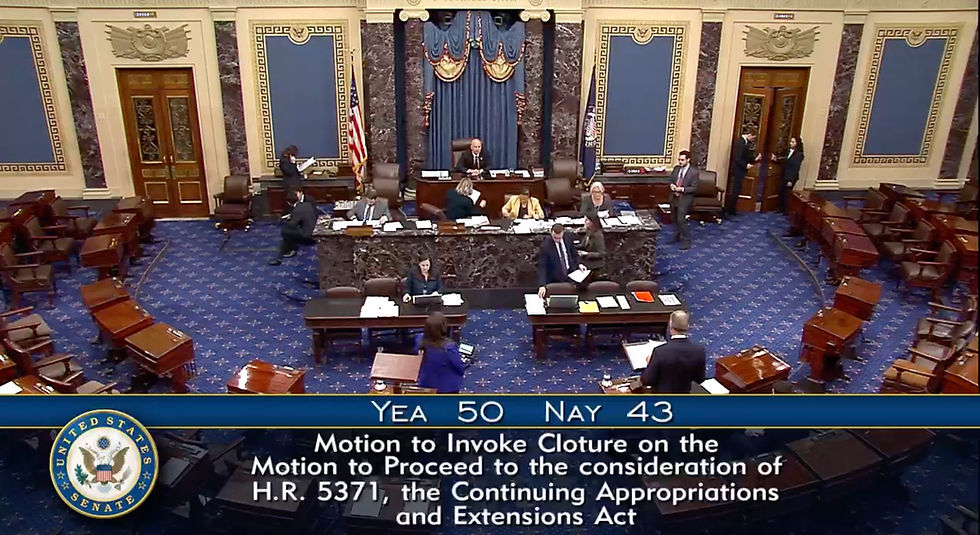
For the 11th time this fiscal year, the U.S. Senate has failed to pass a Continuing Resolution (CR), pushing America closer to its longest funding lapse in decades. The 50–43 vote reveals more than budget dysfunction — it’s proof that partisan warfare, Trump-era control tactics, and political theater have replaced actual governance.
Senate Democrats blamed House Speaker Mike Johnson for refusing to advance a “clean” funding bill free of partisan add-ons. Republicans countered that the proposed resolution failed to address border security and ballooning federal debt. The impasse underscores the widening rift between moderate and hardline factions within both parties, especially as the 2026 election cycle looms.
This repeated failure has already triggered partial furloughs across multiple agencies and disrupted critical programs, including military pay, small business loans, and food assistance. Analysts warn that extended gridlock could shake market confidence, drive up borrowing costs, and weaken America’s credit outlook.
Historically, continuing resolutions have been routine stopgaps to prevent lapses in funding while Congress finalizes appropriations. However, since 2010, CRs have increasingly become political leverage points. This eleventh failure is unprecedented in modern legislative history and signals deep structural dysfunction in Congress’s budget process.
Defense officials have expressed concern that the continued stalemate undermines readiness and national security planning. “You can’t run a global military on 45-day increments,” one Pentagon budget officer noted. Meanwhile, federal employee unions are preparing contingency plans and legal actions should furloughs expand.
Why the Senate isn’t passing the CR
Here are the main reasons:
Democrats are demanding healthcare subsidy extensions. Senate Democrats say that any funding deal must include a guarantee of extended tax credits (under the Affordable Care Act / ACA) for low- and moderate-income Americans. They argue that the credits sunset at year-end and that delaying them is unacceptable.
Senate Democrats … are calling for any CR to include a permanent extension of enhanced ACA tax credits.
Republicans say they can address the healthcare subsidy issue after they reopen the government, not as a condition for reopening.
Procedural/filibuster barrier. Even though the House passed the CR, the Senate fails because it does not reach the 60-vote threshold to overcome a filibuster (or get to final passage). For example: “The Senate Sept. 19 failed to adopt a continuing resolution by a 44-48 vote … The Senate needs 60 votes to pass a funding bill.”
Partisan and intraparty divides
Democrats: Some are willing to reopen the government; others are holding firm for policy demands.
Republicans: Some prefer a “clean” CR (i.e., only funding, without policy riders) while others want policy changes; some are frustrated that the House is in recess and not engaging further.
The House Speaker (Mike Johnson) has kept the House in recess until the Senate acts, which complicates momentum.
Negotiation strategy / leverage. Senate Democrats are using the shutdown as leverage to extract policy changes rather than simply funding. They believe if they reopen without a deal on ACA subsidies, they will lose bargaining power. On the flip side, Republicans (and some Senate leadership) are saying: we’ll reopen the government, then negotiate; we cannot hold up everything now for one policy demand.
Timing and deadlines. The CR that the House passed would extend funding to November 21 (in one version) but that still leaves major negotiations for longer-term funding ahead, which both sides see as problematic. Meanwhile, federal agencies, workers, and programs are under strain because of the shutdown, increasing pressure but also risk for either side.
What a ‘Clean CR’ Really Means

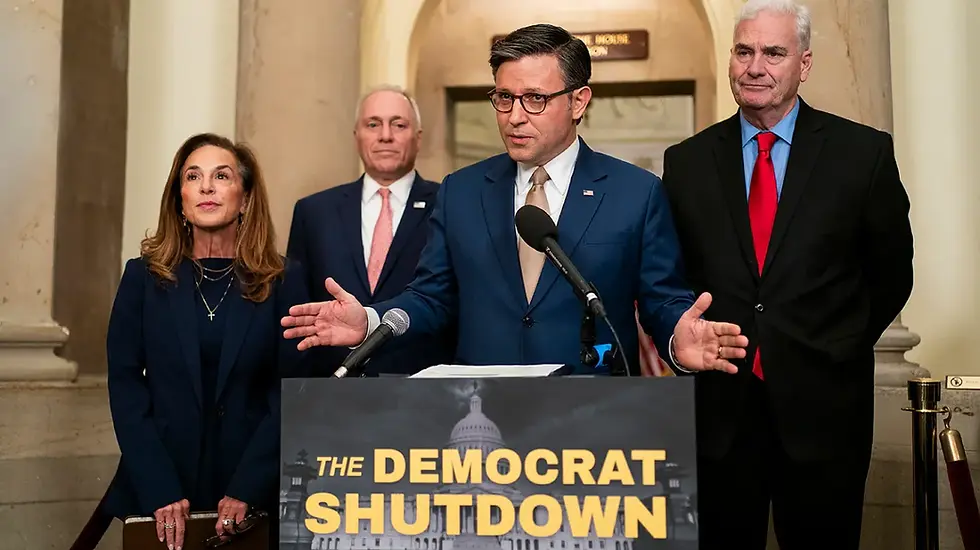
Speaker Mike Johnson keeps calling it a “clean CR,” but that’s not exactly accurate — and anyone who understands how Congress funds the government knows why.
A continuing resolution, or CR, is supposed to be a temporary stopgap measure that keeps the federal government funded at the same levels as the previous fiscal year until Congress passes the full appropriations bills. In plain terms, it’s a bridge — not a rebuild. It keeps the lights on, pays federal workers, and prevents agencies from shutting down while lawmakers argue over the long-term budget.
In the Senate, a “clean CR” means exactly that — no policy riders, no cuts, no gimmicks. Just a time extension to negotiate. It’s meant to be neutral, so both parties can support it without swallowing ideological poison pills.
But the version Mike Johnson pushed through the House isn’t clean. It may not include headline-grabbing culture-war riders, but it quietly locks in conservative funding priorities — trimming domestic programs, delaying certain Biden-era initiatives, and reshuffling how agencies can use their money. It’s a political Trojan horse wrapped in the word “clean.”
So when Johnson calls it a “clean CR,” it’s really more like “lightly bleached” — just enough to look neutral on TV, but still carrying political additives that Democrats won’t swallow. The Senate knows the difference — which is exactly why they’re refusing to pass it.
Behind the Scenes Tho'...
Let’s be real — Donald Trump is the one calling the plays in the House right now, not Speaker Mike Johnson. Every move, every stall, every “no deal” with Democrats traces back to Mar-a-Lago. Trump has been pressuring House Republicans not to negotiate, warning them that cutting a deal before the election would make them look weak and cost him leverage.
This shutdown isn’t about fiscal discipline — it’s about control. Trump wants to freeze the process so that he, not Congress, decides what gets funded and when. By choking off government operations, he tightens his grip on the GOP and positions himself to dominate the next round of budget and appropriations fights.
The House isn’t legislating anymore — it’s waiting for orders. And this shutdown won’t end until Donald Trump says it does.
When the President says out loud that he wants a continuing resolution to “close up Democrat programs” but keep “Republican programs that work,” he’s already admitted this isn’t a clean CR — it’s a political weapon.
Remember, by definition, a clean continuing resolution (CR) is supposed to extend government funding exactly as is — the same levels, the same programs, the same scope — just for a limited time while Congress hammers out a full budget. It’s meant to keep the lights on, not pick winners and losers. Once a CR is used to target or eliminate programs based on political party, it’s no longer “continuing” anything — it’s rewriting the federal budget through the back door.
So if the intent behind this CR is to defund programs Democrats support — whether that’s healthcare access, environmental protections, or community grants — while protecting Republican priorities like defense spending or border enforcement, that’s not a neutral fiscal measure. That’s an appropriations purge dressed up as fiscal responsibility.
Calling that “clean” is like calling a rigged deck of cards “fair.” A clean CR doesn’t pick sides. The moment the White House admits its goal is to permanently close Democratic programs while safeguarding Republican ones, it ceases to be a stopgap — it becomes a partisan power play to reshape the federal government by attrition.
This shutdown mirrors Donald Trump’s signature business style — using chaos as leverage. In his corporate days, Trump often stalled payments, filed strategic bankruptcies, and threatened lawsuits to force concessions from partners and contractors. The same pattern now plays out in politics: create instability, then exploit it for control. According to Politico(Oct. 2025), Trump personally told GOP leaders that “a little chaos in Washington helps the campaign,” urging them to block any bipartisan deal until he gives the green light. House aides confirmed to The Washington Post that members have received direct calls from Trump and his political team warning that supporting a compromise CR “would be seen as disloyal.” In other words, the shutdown isn’t a governance failure — it’s a deliberate business model built on manufactured crisis.
What it boils down to...
In short: the Senate isn’t passing the CR because the funding bill is not enough for one side (Democrats insist on healthcare subsidy policy fixes), and the other side (Republicans) are unwilling to put those fixes into the CR as a condition for reopening lest they provoke the ire of Donald Trump. The procedural hurdle (need 60 votes) further complicates things. There is a strategic standoff: if you give in now, you might lose leverage later; if you don’t give in, the shutdown drags on.
So even though on the surface a “clean CR” might seem straightforward, the political and policy demands make it anything but.

Why Senate Republicans Are Cracking
Senate Republicans appear to be growing increasingly weary of the ongoing government funding standoff. Each vote on the continuing resolution (CR) has seen fewer members willing to stand firm behind the effort. The latest vote came in at 50 yeas and 43 nays, totaling 93 votes cast — with Sen. John Fetterman noted as absent. That leaves three Republican senators who were present but declined to vote, a subtle yet significant signal of fatigue within GOP ranks. Earlier in the standoff, support peaked at 55 votes in favor. The gradual decline suggests that the longer this battle drags on, the less unified Republican backing appears to be — a potentially troubling sign for the durability of former President Trump’s shutdown strategy.
According to the Brookings Institution, each week of a shutdown drains an estimated $1.4 billion from GDP. Federal unions say morale is at a historic low, with workers “treated like pawns in a political game.”
This steady erosion of support exposes deeper cracks in the GOP’s strategy — and perhaps, in Trump’s influence over Senate Republicans. Lawmakers who once rallied behind his calls for “holding the line” on spending are now quietly signaling discomfort with the political costs of prolonged gridlock. Behind closed doors, aides describe mounting frustration from constituents, business groups, and defense contractors feeling the effects of federal uncertainty. The optics of loyalty are beginning to collide with the realities of governance. As paychecks stall and public patience thins, even some of Trump’s most reliable Senate allies appear to be calculating the long-term fallout — not just for the party, but for their own re-election prospects.
Ghetto Philosopher Policy Analysis
Washington’s continuing resolution stalemate isn’t a budgeting glitch—it’s the same tired circus wearing a new fiscal costume. Every year, Congress drags the country to the brink, pretending dysfunction is strategy. But there are exits if lawmakers cared more about governing than grandstanding. A clean CR can buy time to stabilize operations, a mini-omnibus can move consensus funding forward, and an automatic funding trigger could finally stop federal workers and contractors from being used as bargaining chips. However, each fix comes with a warning label: clean CRs delay the inevitable, mini-omnibuses can disguise deeper rot, and automatic triggers risk dulling accountability. Still, they’re better than another performative shutdown staged for campaign sound bites and cable news clips.
The truth is, this isn’t about numbers on spreadsheets—it’s about nerve. The federal government is stuck in a culture of crisis where chaos passes for control. Behind those budget battles are real people: soldiers waiting on paychecks, small businesses losing invoices, parents unsure if their childcare subsidies will clear next month. The cost isn’t abstract—it’s personal. Until lawmakers break their addiction to brinkmanship and treat governance like duty instead of theater, America will keep living paycheck-to-paycheck on Capitol Hill. So, the next time your representative brags about “fighting for fiscal discipline,” ask them one question: What’s the plan beyond kicking cans and cashing checks?
The 1995, 2013, and 2018 shutdowns were all triggered by partisan budget disputes — but none came close to this year’s eleven failed CR attempts. That pattern signals not just gridlock, but decay in the governing norms that once protected basic operations.
This isn’t just a partisan fight; it’s a test of how much chaos voters are willing to tolerate. If Americans keep rewarding politicians who weaponize dysfunction, shutdowns will become our new normal. It’s time to demand competence — not slogans — from every seat in Congress.
What to watch
Whether Democrats will accept a stand-alone vote on the ACA credits after reopening, rather than as a condition.
Whether Republicans will modify the CR to include policy riders (or agree to combine the subsidy extension with reopening).
Whether the House will reconvene and engage in negotiations vs staying in recess.
How public and constituency pressure (on federal workers, agencies, etc) might force a shift.
Timing: as deadlines approach (e.g., Nov 21 or other fiscal milestones), pressure will increase and the calculus may change.


Comments